
Lesson 4: Making Mindful Money Decisions

Learning Objective
Learn how to make mindful money decisions with confidence

As we know, decisions are best made when we use our intellect and our intuition, we process our emotions and we consider the practical outcomes of our choices. In other words, when our head and heart are in alignment. Aligning what we truly think with how we really feel.
We can take this process one step further by aligning our decisions with our values and applying a mindfulness approach to our decision making process.
Using our Values
In knowing our values, we’re more aware of what is important to us. We can use these factors to help guide us in the right direction and help us make better choices. It can also be easier to make decisions when using our values. By using our values to drive our decisions, the decisions become much clearer and we find that many of our decisions are made before we even encounter them.
We can use our values in our decision making by asking:
- Does this choice lead me closer to my goal?
- Do this choice reflect my personal values?
- How will this choice impact me in the long term?
Applying Mindfulness
Mindfulness is often defined as maintaining a moment-by-moment awareness of our thoughts, feelings, bodily sensations and our surrounding environment. These situations, surroundings, thoughts and feelings can all distract and confuse us or impact our judgement in some way.
We introduce a mindful approach to our decision making to slow the process down and include both sides of the brain: Left Side – thought and logic with our Right Side – emotion and intuition.

Mindfulness is self-awareness.
It means to be conscious of what is going on in our mind and is the act of watching our thoughts.
Without self-awareness, we are at the mercy of our minds because we are living the thoughts as they arise.
With self-awareness, we have a choice about what we think about.
The goal of mindfulness is to free our mind of outside influence so that we can be clearer and have more perspective. When it comes to our wealth/finances, creating a mindfulness practice involves learning to ignore the distractions and make decisions that are more reflective of what it is really important to us.
Mindfulness is an essential tool in creating wealth. When we are mindful about our relationship to money, how we spend and make financial decisions, we are more likely to achieve our goals, reduce stress and be in control of our situation.
Becoming mindful feeds more blood to our prefrontal cortex (the front part of the brain), which helps to improve our decision-making.
Becoming mindful helps to lowers cortisol levels, which reduces the stress that often comes when making key decisions. If we’re calm, then we’re more likely to make informed and appropriate decisions than if we are in a state of stress.
To get into a mindful state doesn’t take long and with practice the time it takes does actually reduce. Typically, it can take anywhere between 15 seconds and 5 minutes. The easiest way to practice mindfulness is to first focus on our breathing and be present in the moment.
Mindful exercise: The purpose of this exercise is to simply notice, accept and be aware of your breath – it is not about relaxation or stress reduction, although this may well occur.
Breathing is something we all do – if you have a pulse then you breathe. Your body knows how to do this; it has done it since birth. This is simply about breathing mindfully. Breathing is something you carry with you everywhere; you are just not usually aware of it.
Inhale. Exhale. Listen.
Click here and listen to A Breathing mindfulness mp3.
We begin to observe all our thoughts, emotions and physical sensations that are present in our body. Focusing on how we feel, here and now we begin to notice thoughts and feelings – and we are curious about them. We don’t have to judge them or question them, but just notice what is arising for us. This provides us insight into some of the messages and perceptions that can potentially influence our decision-making behaviour. Often we are unaware of these outside influences and their emotional force on our decision making process and we can end up making decision that we don’t feel 100% in alignment with. This is particularly the case when it comes to making important money decisions.
Mindfulness can also help us tap into our intuition. Intuition is most often noticeable as physical sensations such as a bad feeling in your chest about one decision, or a feeling of excitement in your gut about another decision. Our intuition can be difficult to notice if we have a lot of other things going on but by taking the time to be still and be present, focussing on our breath, we can connect with our inner sense of knowing or intuition – even if it’s only for a couple minutes.

In short mindfulness assists us with our decision making with money by:
- Puts the decision into perspective.
- Heightens our awareness of our own values and objectives
- Allows us to recognise the limits of our own knowledge
- Helps us deal with uncertainty
How do we make important money decisions?
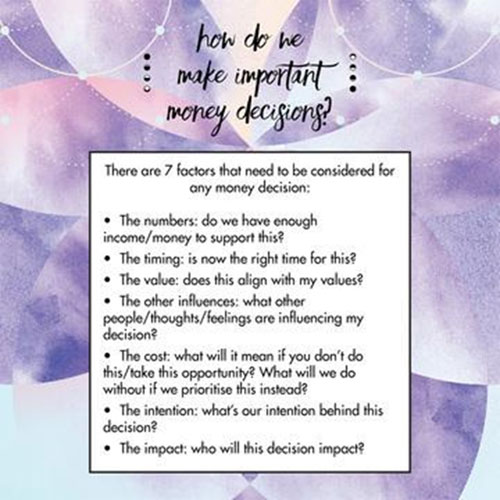
Mindful Question/Reflection: We can’t make the right decision all the time, sometimes when we’re forced to make decisions without enough time or information, we can make the wrong choice.
But even if it our decision doesn’t turn out the way we wanted or expected, we can use it as a learning experience for future decisions by asking ourselves:
- Did I give myself enough time to make the decision?
- What could I have done to make a better decision?
- What did I learn from this process?


