
Lesson 3: Conscious Investing

Learning Objective
Developing a conscious attitude to investing
When it comes to our investing, we can also apply the same value system that we use to make our decisions, to how we invest and where we put our money.
We might choose to invest our money in businesses that are socially responsible, assist the community or promote protection for the environment and animals – investing in ethical.
Investment options typically done for a financial gain and to know that your money is supporting businesses that are performing social good.
On the flip side, we may choose to avoid specific companies that produce weapons, or are bad for the environment, animals or people.
Many of us don’t realise that when it comes to our money, when we spend or invest it, we are actually casting a vote in how we want the world to be – we can either support the businesses that will make the world a better place, or support the ones that won’t.
When we buy shares in a company we support them in their business activities. I am sure many of you will say, but I don’t own shares. But the truth is most, if not all of you, do own shares – think, shares in your superannuation funds.
After our homes, superannuation is likely to be our second biggest asset that we have in our lifetime. Most of us don’t really care how or where our superannuation is invested, or what it’s used to support. These days there are many ethical, socially responsible and green investment options for your investments and superannuation. There are also ethical banking and mortgage options too.
It’s an area that’s gaining more awareness globally and something that is worthwhile thinking about.
Conscious investing is taking notice of what we are doing and where we are putting our money.
Another form of mindful investing is bringing awareness to how our emotions influence our investing mindset.
The role and influence of media on our investing
Have you ever heard the saying; never let the truth get in the way of a good story?
The media plays a very significant role of influence on our thoughts and emotions. And it’s not different when it comes to reporting on all things financial. If we were to watch the finance section of the news or read the paper, we’re more than likely to hear reports of how well or how bad the stock market is doing any particular day. Whilst there is truth that investments, shares, interest rates and the value of our dollar will go up and down over time, as the media is rewarded by readership and ratings they often sensationalise stories in order to produce a good headline and entice us to read or watch.
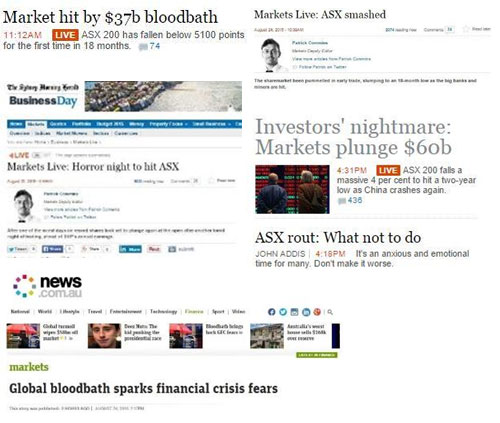
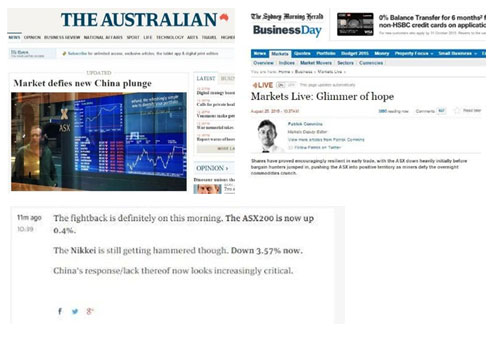
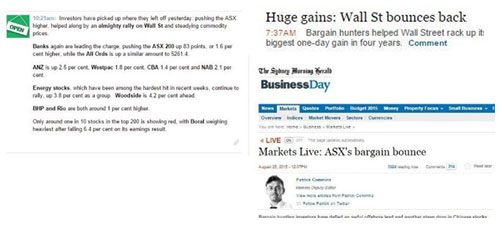
If you pay attention to the media, you will notice that they often use highly emotive words to get us to take notice. If there are movements in our dollar or in share prices, they may report on them in a way which can be quite dramatic. In fact, when it comes to investing, the share market or finance in general, they love to use negative words like; smashed, dipped, bloodbath, financial crisis, crashed, horror, biggest fall, meltdown, panic and then there are the positive words; soared, surged, recovery, rallied, biggest rise since . . . and resilient.
When we are exposed to conflicting or emotive messages it can make it very difficult to make calm, rational or even sensible decisions when it comes to our finances.
Let’s look at a real life example of the roller coaster of messages that the media takes us on when it comes to reporting on finance over the span of one to two days.
Bad News for investors, 24 August 2015
Hopeful news for investors, 25 August 2015
Good news for investors, 27 August 2015
Source: Quantum Financial Advice LinkedIn article
It is important to be aware of these messages, yet not get caught up in the hype; seek out reliable information in relation to your own situation and investments.
When we see emotive words being used in headlines, it is a signal that we may need to take into account what emotion they are trying to create in us. Being conscious of these tactics and mindful of their impact on our own thoughts, emotions and behaviours can assist us to make better decisions and act with more awareness when it comes to our own money and investments.
Mindful Reflection/Question: Have you listened to the news and heard the financial updates?
What emotions are stirred in you, fear, greed and meltdown or panic?


