
Lesson 2: The Impact of Money on Wellbeing And Stress
Learning Objective
Understand the role that money plays in your life and the importance of managing wealth for our wellbeing. Identify the four elements of financial wellbeing.
The Energy Of Life
Wellbeing is how we feel, our overall state of being well in our health and happiness, and whether we feel satisfied and content.
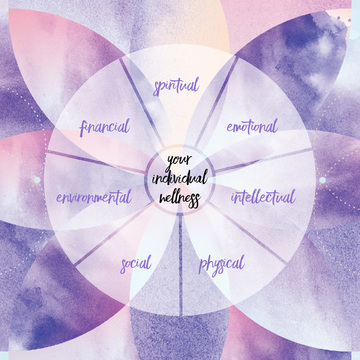
Our lives are a giant wheel.
Let’s call it our Wellbeing Wheel.
At the pivotal centre of our life wheel is our energy.
Our energy floods out into all areas in our life – our health, relationships, career, and communities.
Think of the word interconnected.
“You are never alone. You are eternally connected with everyone.”
– Amit Ray
Meaning, we are all one and even though every element in our lives is interconnected, we often separate our lives into compartments. We focus on just one or two aspects of our wellbeing and forget about the rest. We might focus on our study or our career and neglect our social, physical or emotional wellbeing. Or we might focus on our relationships and family at the expense of our spiritual or financial wellbeing. But without connection and free flowing energy to all of these elements that make up our life, we cannot have whole wellness and we do not have balance.
Money is Part of Your Wellbeing Wheel
In conversations surrounding money or our finances, we tend to detach or fail to associate our money with our health and wellbeing.
Yet money has a direct impact on our ability to feel and lead a happy fulfilled life. While money cannot buy wellbeing, it is essential to have enough money to provide our basics and some of our desires in life. In some ways money is like oxygen. We need a certain amount of it to survive.
Finances are a key segment of our Wellbeing Wheel. Remember, if the energy in one element of our lives is out of balance, this will flow on and could have a lasting impact on our mental and physical health and affect all other parts of our life. So if we are feeling financially stressed, it is very important for us to take action.
Optional Activity – Total Wellbeing Assessment
Money & Stress
Stress is a condition or feeling that we experience when we feel like we are under pressure or we don’t have control.
Worrying over not having enough money, having trouble making ends meet or carrying too much debt can result in us feeling worthless and can impact our happiness and wellbeing by increasing our stress.
#Truth
49% of Australians say that personal financial issues is the leading cause of stress in their lives.
The Australian Psychological Society (APS) researches Australians’ stress levels every three years and releases their findings in the Stress and Wellbeing in Australia Survey.
In the most recent survey conducted in 2014, they found that personal financial issues are the leading causes of stress among Australians aged 18 to 45 and that women are more likely than men to list personal financial issues as their main cause of stress.
The equivalent report issued by The American Psychological Association titled “Stress in America, paying with our health” released in February 2015 had even more concerning stats with nearly three quarters (72 percent) of adults reportedly feeling stressed about money and nearly one-quarter saying that they experience extreme stress about money. Their report also found that women reported higher levels of stress about money than men.
Mindful Question/Reflection
Does your current relationship with money cause you stress?
Why are we constantly worried about money?
Are we afraid of losing it; anxious about not having enough; scared we will never take that overseas trip; support our children comfortably; pay our mortgages; live our dream life; is this it? Every thought surrounding money can unveil stress.
And if we are someone who spends more than we earn, or are in the habit of continually maxing out our credit cards, this only adds to our stress levels and feelings that a life of abundance may be unachievable.
Mindful Question/ Reflection Do you see stress as a challenge you can meet or an overwhelming burden that you can’t manage?

Overcoming Financial Stress
In order to invite more health and wealth in our lives, it’s important that we learn how to recognise our triggers of stress. Only then can we begin to change the behaviours that contribute to our stress levels.
It is often said; stress is directly related to how out of control we feel.
When we feel that money controls us, it often creates a sense of loss of freedom or independence to live our life the way we want to. If stress is a direct result of how out of control we feel, then we can directly reduce stress by taking back control, how?
By seeking to understand our thoughts, habits, attitudes and actions towards money: replacing limiting habits and actions with more positive attitudes and behaviours.
As we create wealth and financial wellness together, we must continue through this course to keep in our mind’s eye our relationship with money and the effects money has on all other areas of our life and wellbeing.

The way that we approach our money is the same way that we should approach all other areas of our lives: Through an interactive process of becoming aware and practising healthy choices.
These two actions will help us create self-awareness around how we relate to money and assist us in creating balance in the way we manage our money.
When we create an awareness of our habits, thoughts, feelings and emotions around money and wealth, we develop a better understanding of what we do and why we do it. This gives us our power back and a sense of control with money.
Moving from Stress to Financial Wellbeing
Financial wellbeing is being and feeling financially healthy and secure – it’s personal for women as we each hold our own epitomes surrounding our finances and wellbeing.
It is said that there are four essential elements to wellbeing: Control, Resilience, Goals & Freedom of Choice.
The four key elements to financial wellbeing (by The Consumer Financial Protection Bureau) are essential on our path to virtuous wealth and wellbeing, they are:
- CONTROL – Having control over our finances in terms of being able to pay bills on time, not having unmanageable debt, and being able to make ends meet.
- RESILIENCE – Having a financial “cushion” against unexpected expenses and emergencies. Having savings, health insurance and good credit, and being able to rely on friends and family for financial assistance were factors that increase your capacity to absorb a financial shock.
- GOALS – Having financial goals — such as paying off student loans within a certain number of years or saving a particular amount towards a house, overseas trip or financial independence — and being on track to meet those financial goals also made people feel like they were in good shape financially.
- FREEDOM OF CHOICE – Being able to make choices that allow you the freedom to enjoy life — such as taking a holiday, enjoying a meal out now and then, being able to pursue your passion, or working less to spend more time with family — was also deemed an essential ingredient in financial wellbeing.
Or in other words; financial wellbeing implies having financial security and financial freedom of choice both in the present and in the future.
| Present | Future | |
|---|---|---|
| Security | Control over your day-to-day, month-to-month finances |
Capacity to absorb a financial shock |
| Freedom of choice | Financial freedom to make choices to enjoy life |
On track to meet your financial goals |
Mindful Exercise
Reflect on your current situation and relationship with money. Can you rate your level of financial wellbeing from 1 to 5 (1 being less confident, 5 being most confident)?
 I am in control over my financial situation.
I am able to make ends meet, pay my bills on time and I have manageable debt levels.
I have the capacity to meet unexpected or unplanned expense
I have savings, adequate insurances and support from family or friends
I set and am working towards my financial goals
I set goals and targets to keep me on track to make my financial goals a priority
I am free to make choices in life
I have the freedom to make choices that I know will bring me more happiness and wellbeing in my life
When you’re ready, click to move on to lesson 3 of this module. It’s time to stop confusing net worth with self-worth!


