
Lesson 4 – Defining Happiness and Financial Success
Learning Objective
Articulate our own definitions of wealth, happiness and success
What makes one person more successful than another?
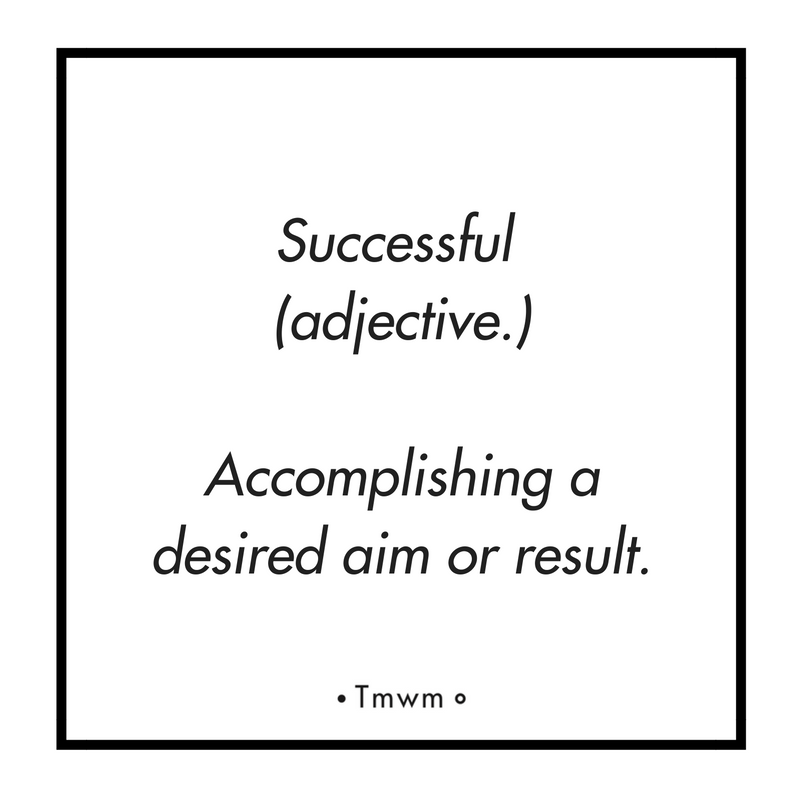
Success is the opposite of failure. It’s typically defined in two ways:
- The achievement or accomplishment of our vision or goals, or
- Attaining a certain social status such as being rich or famous.
There is a metaphor that success is like a ladder: with each achievement we make; we climb a rung to success.

We may find that we work hard to reach the top of the ladder, only to discover that the ladder is up against the wrong wall — or, that we’ve achieved success in something that we don’t actually value or that someone else values for us.
Mindful Question / Reflection:
Is it better to be at the bottom of a ladder we want to climb than the top of one we don’t?
Mindful Question / Reflection
Do you think that your current definition of success is your own, or someone else’s that you’ve taken on as your own (maybe a parent, or your siblings, your partner, or even your friends or society?)
True Success
Alicia wasn’t really sure of what she wanted to do when she left school, she had a passion for art, but her parents thought a degree in Accounting would mean a secure job and a promising career. Alicia also liked numbers and maths and she didn’t want to disappoint her parents, so enrolled in Accounting at University in order to get the qualifications she needed to secure a job. After graduating she scored a good job with a big accounting firm in the city. She was good at her job and very soon she started to earn good money. She bought a nice car and wore nice clothes and was saving a deposit for an apartment. To her friends and family, Alicia was successful but as the time passed, Alicia felt more and more unfulfilled. Whilst her job represented security and good money, she wasn’t passionate about it or inspired by it.
Does this mean she wasn’t successful?

I’m sure we’ve all heard similar stories before perhaps with careers, relationships, dreams or other goals. It’s a common scenario for women to pursue someone else’s definition of success as their own. But the problem with this is that it often leads to feelings of resentment, lack of purpose, direction or a feeling of not belonging.
In our society, we typically measure success in the same way we measure our self-worth: by using external measurements. We think that if someone has a big house, nice car or fancy job then they’re successful.
When we use these external measurements of success it’s still possible to be successful but also feel unfulfilled and unhappy.
When it comes to personal success:
Success is about achieving the goals that we set for ourselves.
Mindful Question/Reflection
Can you define what is success means to you personally? It can be easier to define this if you try imagining your life in a few years. You’re very successful. What are you doing/how do you spend your time? Who are you with? Where are you living?
Put aside for a moment what society, the media, our friends or family tell us that we need to have or be in order to be successful. And take a moment to think about how we personally define success on our own terms.
The beauty of creating our own version of what success means is that:
- We’re more likely to achieve it.
- We’re more likely to be fulfilled.
- We’re less likely to do things to please others.
- We’re likely to feel more satisfied when we reach our own definition as opposed to someone else’s.
- We get to measure ourselves against our own definition.
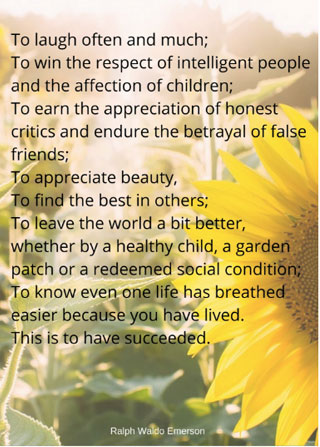
Ralph Waldo Emerson defined success beautifully when he said:
To laugh often and much;
To win the respect of intelligent people and the affection of children;
To earn the appreciation of honest critics and endure the betrayal of false friends;
To appreciate beauty, to find the best in others;
To leave the world a bit better, whether by a healthy child, a garden patch or a redeemed social condition;
To know even one life has breathed easier because you have lived.
This is to have succeeded.
Ralph Waldo Emerson
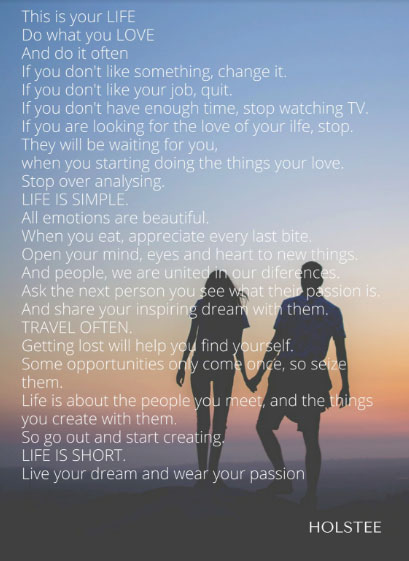
Another of our favourite definitions of success is the one created by the founders of the company Holstee. To create the Holstee Manifesto the founders wrote down everything important to them from their values to food, relationships, and travel to their hopes and dreams. The goal was to create something they could reflect back on if they ever felt stuck or found themselves living according to someone else’s definition of success or happiness.
Comparison
It’s human nature for us to define ourselves and evaluate our lives by comparison and contrast with others. Generally speaking, if we have the same as everyone else, we feel equal, if we have less, we feel inferior and if we have more, we feel superior. The size of gaps also matters. If we have a lot more than others, then we may feel more superior than them.
This social comparison often appears in forms of status, which is one reason we are driven to purchase status symbols that signal to others and to ourselves, that we are better in some way — richer, more successful, happier or prettier.
Whilst it’s important to embrace and be inspired by the people around us, we shouldn’t compare ourselves to them.
Theodore Roosevelt famously said, “comparison is the thief of joy.”
And we tend to agree, here’s why:
- No two of us are alike.
- We all come from different backgrounds, have different earning capacity, experience, knowledge, education, goals, values and beliefs.
- We are all on a different and unique journey from each other.
- Financial freedom means different things to each of us.
- Comparison steals our focus — we focus on what we don’t have, rather than what we do.
- We’re part of a community — competition creates rivalry.
- There is no finish line — life is not a competition.
Mindful Activity – Turning Comparison into Inspiration
Can you think of someone who you sometimes compare yourself to, who seems to have it better than you do when it comes to finances?
What is it about their financial life that seems better than yours? Is it that they make more money than you, or that they’ve paid off their debt, or that they’re good at saving or investing?
The thing with envy is that it often gives us an insight into what we actually desire ourselves.
So let’s go back to that person and change our envy and comparison into inspiration. The fact that this person has done something we want actually proves to us that it is achievable. If they can do it, we can do it too.
Instead of focussing on the fact that they have it and that we don’t, let’s focus on the fact that it’s something we can have too if we aspire to it.
Happiness
We often hear the phrase: Money can’t buy you happiness but the truth is, it actually can to a certain point.
There have been many studies on the relationship between income and happiness and the exact amount of money we need to be happy has recently been identified in a global research project. The study found that those with a total household income of less than $75,000pa had lower levels of emotional wellbeing and satisfaction in life. But those households with an income above $75,000pa didn’t necessarily see any significant increase in their happiness.
What does this mean?
The research suggests that we all need money to survive and we need enough of it to meet our needs and some of our wants.
Having an abundance of money in our life can bring us:
- More control in our lives
- Choices and freedom to do the things we enjoy
- More free time to spend with our loved ones
- Longer, healthier lives
- A buffer against stress
But having more money doesn’t always increase our happiness — here’s why:
The happiness around buying and acquiring things eventually wears off. We begin by feeling excited with our new purchases, but over time we have a tendency to take them for granted — we lose our excitement — then, we find other things to gain the same elevated feelings again. If we’ve used credit or borrowed money to purchase these things, we might even resent the commitment to paying it off and meeting repayments.
Most of us tend to adjust our expectations upwards, so as our incomes rise, so too do our desires. We might begin to buy $15 bottle of wine, instead of $10 bottle, we might shop in designer clothes stores, or eat at fancier restaurants.
Our desires become insatiable and the more we have, the more we want. We are constantly bombarded with advertising on the latest, greatest, must have versions of products and things we already have. Understanding this is key to taking control of our wealth.
Just because we want something, doesn’t always mean we have to have it!
How can we spend our way to happiness?
Elizabeth Dun, Dan Gilbert and Timothy Wilson conducted research on how we can use our money to make us happier, and published their findings in a report titled: “If Money Doesn’t Make You Happy Then You’re Probably Not Spending It Right.”
Their tips for spending money to create happiness were:
- Buy fewer material things and more experiences
- Use money to help others
- Buy fewer expensive things in favour of less expensive items, more frequently
Mindful Question/Reflection One of the biggest misconceptions about wealth is that having more money or more things will make us happier. Is that a belief you hold?
“Things” only provide limited satisfaction in our lives, but what does bring us lasting satisfaction and happiness is our relationships with each other, our experiences, our connection with nature and our sense of purpose and meaning and belonging.
Having a lot of money in the bank won’t take away our problems unless they are purely money related.
While more money may bring more financial freedom and happiness the truth is we can’t buy happiness, or at least not a true happiness that will fulfil our lives.
Why?
Because Happiness is a state of mind.
Imagine for a moment that we make a mistake at work and we get dismissed from our job. This is very upsetting and we’re likely to be judgemental and criticising towards ourselves for getting into this situation. We may even be angry with our former employer and worried about our future.
Now, fast-forward a few years. Imagine if by getting dismissed from your job you took the opportunity to re-evaluate your career path and instead of looking for a new job you decided to re-train and start a new career in a job you love and you are now happy in our new career!
See how the event of being dismissed was a positive thing in your life and one, which was necessary for you to get to where we are now.
Did the event actually change? You were still dismissed, for the same reasons on that day. The thing is, it’s not the event that makes us happy or sad. It’s the way we interpret it. Our perceptions and opinions of the same event that changed, and so do our emotions from being sad to happy.
Most of us only change our perceptions and interpretations of events with time or the benefit of hindsight; however, with awareness, we can actually change our opinions and beliefs on events in the very moment that they happen in our life.
Don’t let your happiness be controlled by something you can’t control.
Mindful Question / Reflection
Can you name a current event or perhaps something that has occurred in the past which at first seemed negative, but later on turned to be beneficial or helpful? Perhaps it was a relationship ending, a change in jobs or an event that was unexpected?
To be happy, we first need to decide to be happy – regardless of our problems or challenges.
One of our greatest powers is our ability to focus on the good and be happy right now in this moment, no matter what is happening around us.
A statement many of us use is, “I’ll be happy when…”
For example, “I will be happy when I get a promotion” or “I will be happy when I meet someone” or “I will be happy when I have more money.”
By thinking this way, you’re making your happiness reliant on something external and something that is potentially out of your control.
Mindful Question / Reflection
Can you think of a “I’ll be happy when…” statement that you have in your life?
When you’re ready, move on to the final lesson in this module – for the very important step of determining your starting point and a simple map for the rest of your journey.


